
Every host asks the same first question: how much will this property earn? The more useful question — the one that actually determines whether it’s a good investment — is what it costs to run. Here’s that breakdown for Panama City.
Fixed Costs (you pay these whether or not the unit is booked)
- HOA / building maintenance fees (“cuota de mantenimiento”) — varies significantly by building and amenities. A basic building runs lower; a high-rise with a pool, gym, and 24-hour security in Punta Pacifica or Costa del Este runs considerably higher.
- Property tax (Impuesto de Inmuebles) — Panama’s property tax law includes exonerations for lower-value primary residences, but an investment/rental unit is usually treated differently.
- Insurance — property coverage plus liability coverage for guests staying in the unit. Get a quote specific to short-term-rental use; a standard homeowner’s policy often doesn’t cover paying guests.
- Internet — effectively non-negotiable for guest satisfaction; budget for a reliable, higher-speed plan, not the cheapest available.
- Software / channel manager — if you’re self-managing across multiple listing platforms, budget for a tool to centralize calendars and avoid double bookings.
Variable Costs (these scale with how often you’re booked)
- Cleaning / turnover — the cost per turnover depends on unit size and how far it is from central Panama City; get quotes based on your specific unit rather than a generic city-wide number.
- Laundry — linens and towels washed between every stay; costs scale with unit size and stay frequency.
- Restocking & amenities — toiletries, coffee, paper products, and the occasional replaced towel or sheet. Individually small, but worth tracking from day one rather than absorbing quietly into “miscellaneous.”
Commercial Costs
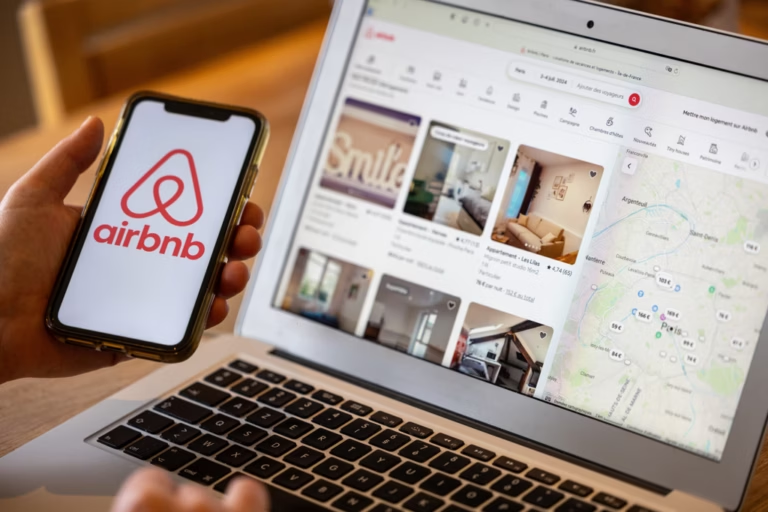
- Platform commission — Airbnb’s fee structure is global, not Panama-specific: under the split-fee model most hosts pay around 3%, while under the host-only fee model it’s typically in the 14–16% range. [Confirm current terms directly on Airbnb — these percentages shift periodically.] Booking.com’s commission varies by property and market rather than a flat rate.
- Full property management — if you delegate operations to a company instead of self-managing, expect a percentage of revenue rather than a flat fee, and expect the percentage to vary a lot based on what’s actually included (pricing strategy, guest messaging, cleaning coordination, reporting) versus a bare-bones listing-only service. Compare scope, not just the percentage.
The Hidden Costs Most First-Time Hosts Miss
A reserve fund. Sooner or later something breaks — the AC, a water heater, an appliance. Setting aside roughly 5–15% of income as a standing reserve means a breakdown is an inconvenience, not an emergency that eats a month’s profit.
Stacked commercial fees. It’s easy to combine a platform fee and a management fee without noticing they’re two separate cuts off the same revenue. The combined total isn’t simply the two percentages added together in every case — but it is often more than hosts expect when they first do the math. Worth calculating explicitly rather than estimating.
Registration and compliance. Panama’s tourism authority (ATP) and Panama City’s municipal government both have requirements around registering a property for short-term/tourist rental use. Treat this as a real compliance item to resolve before listing, not paperwork to get to eventually.
Apportioning costs to actual rental days. If the unit isn’t rented year-round, expenses generally need to be apportioned to the days it was actually available for rent, not claimed in full for a partially-used property.
Want the real version for your actual property? — we quote cleaning and turnover costs precisely, and can point you toward the right accountant for the tax-specific numbers we’re not licensed to give you.